Open source · Go · one binary · MIT
Pipelines where an agent is just another step
steps runs Concourse-style YAML pipelines — get, task, put — from one Go binary, with no server to stand up. It adds agent: an LLM with tool calls, sub-agents, and MCP servers, sitting in the plan beside everything else. Every step is content-addressed and cached in SQLite, checked by assert:, and shown in a run transcript with what it cost.
Read the docs Five pipelines, simplest first GitHub
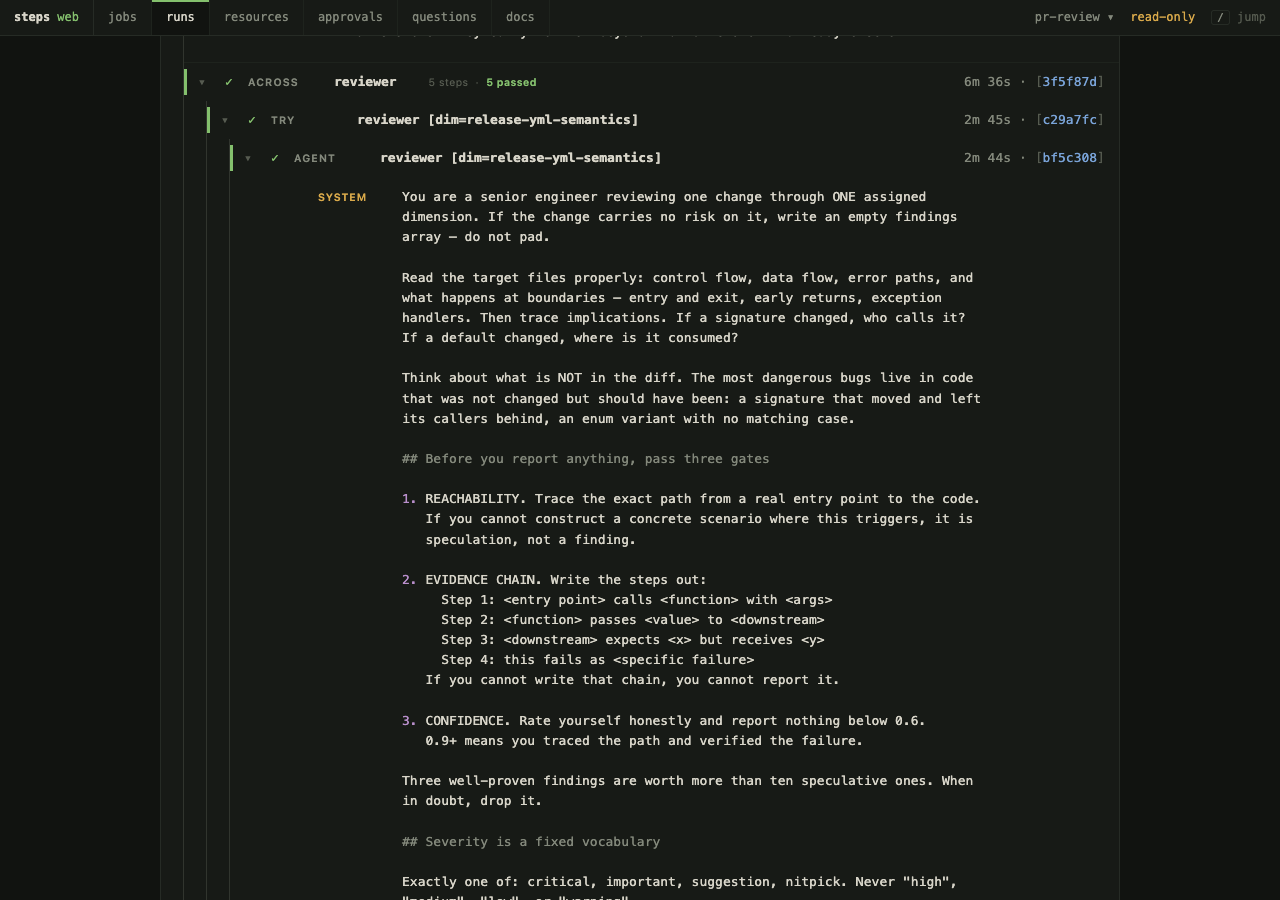
across: block ran one reviewer per dimension, concurrently, each hashed, timed and priced on its own. Fold a block and its row still says what is inside it.cat IDEAS.md — the three the tool is built on
An agent is a step
Same inputs: and outputs: as a task, same cache, same transcript. The tool grant is the security boundary: an agent without edit_file reviews code and cannot change it, and that is a guarantee rather than a line in a prompt.
A model proposes, a deterministic step disposes
verdicts: route the plan on the decision. assert: checks the step wrote what it claimed. approval: parks the run for a person. An agent that reports success while writing nothing is caught by the pipeline, not by you, three days later.
Every step is cached, replayable, priced
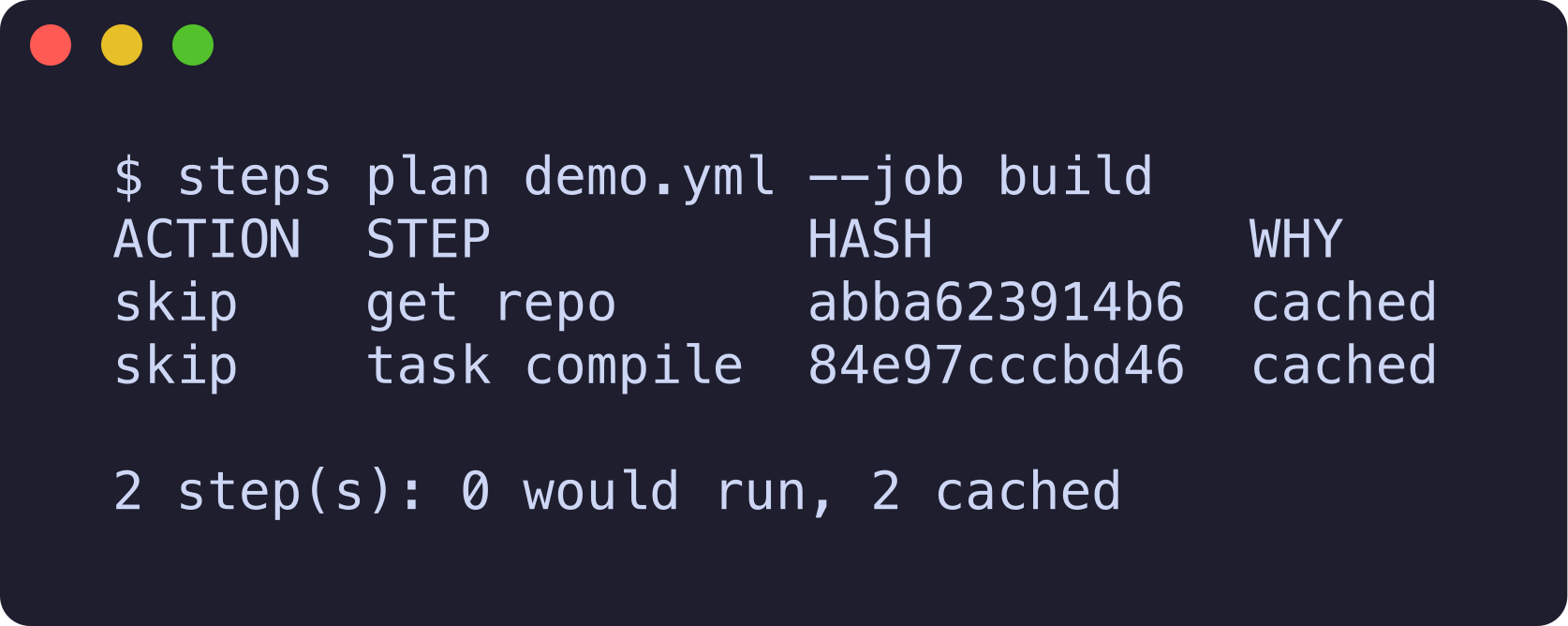
An unchanged commit re-runs nothing, and steps plan says so before anything costs a token. --replay --from re-runs one expensive step against a kept workspace. The transcript shows each step's spend against the ceiling it ran under.
ls examples/ — five pipelines, simplest first
Each one is the previous one plus a single idea, so after the first, each shows only what changed. The last is a real file in the repo.
# No resource_types: block — `git` is built in. Only a resource steps has no
# transport for (an artifact store, an issue tracker) needs one defined.
resources:
- name: repo
  type: git
  source:
    uri: https://github.com/you/app.git
    branch: main

jobs:
- name: test
  plan:
  - get: repo
    trigger: true       # under `steps web`, a new commit re-runs this job
  - task: unit
    inputs: [repo]     # a step sees only what it declares
    run: cd repo && go test ./...
Plain CI first. Every step is content-addressed — the fetch, the command, the inputs it declared — so the second run of an unchanged commit re-runs nothing, and steps plan says so before it costs anything:
steps validate pipeline.yml checks the file and this machine before a run: model names resolve, every api_key_env: is set, every MCP binary is on PATH.
agents:
- name: fixer
  source: { model: openrouter/qwen/qwen3.7-flash }
  system: |
    You repair a failing build with the smallest change that makes it pass.
    Fix the cause in the code under test. Never delete, skip, or weaken a
    test to make it green.
  tools: [read_file, search_files, edit_file, write_file, run_shell]

jobs:
- name: test
  plan:
  - get: repo
    trigger: true
  - task: unit
    inputs: [repo]
    run: cd repo && go test ./...
    fix: fixer          # constructed only when the command exits non-zero
The agent arrives as an escape hatch, not a stage. A green build never constructs it and costs nothing. A red one hands it the failure output and the task itself as a rerun tool — then the command runs one final time, and that exit code is the verdict. Not the model's opinion of its own work.
The run prints note: unit makes this chain uncacheable (fix: agent), because whether it passes now depends on what a model did.
agents:
- name: reviewer
  source: { model: openrouter/qwen/qwen3.7-flash }
  system: You review release notes. Be terse.
  tools: [read_file, write_file]      # no edit_file: it can report, not change

jobs:
- name: review
  plan:
  - get: repo
  - agent: reviewer
    inputs: [repo]                    # exactly what it can see
    outputs: [report]                  # exactly what is kept
    context_paths: [repo/NOTES.txt]    # handed over at turn zero
    max_turns: 8
    messages:
    - Read repo/NOTES.txt and write a one-line summary to report/summary.md.
    verdicts:
    - approve: results               # the decision picks the next step
    - reject: escalate
    assert:
      verdict: approve                # what it decided
      files: [report/summary.md]      # ...and that it wrote the thing
  - task: escalate
    run: echo rejected >&2 && exit 1  # a rejection fails the build
  - put: results                      # approve routes straight here
    inputs: [report]
Now the model steers the plan. verdicts: synthesizes a required tool call from a fixed vocabulary, so the answer is a branch, not prose to parse. steps test runs every job and checks every assert:.
The complete, runnable version is docs/complete.md, which the test suite executes.
jobs:
- name: audit
  plan:
  - get: repo
  - agent: planner
    outputs: [dims]
    messages:
    - |
      Write dims/index.json — a JSON array of the review dimensions this
      change actually needs, and dims/<id>.md for each. Six at most.
      If a dimension carries no risk here, propose nothing. Do not pad.
    assert:
      files: [dims/index.json]       # or the matrix has no width

  - across:
    - var: dim
      from_file: dims/index.json   # width = what the planner just wrote
    max_in_flight: 6               # cells run concurrently
    budget:
      tokens: 3600000              # when spent, no further cells start
    try:                             # one bad cell ≠ a dead matrix
      agent: reviewer
      inputs: [repo, dims]
      outputs: [findings]          # collected: findings/<dim>/report.json
      context_paths: ["dims/{{ .vars.dim }}.md"]
      messages:
      - Review through your one dimension only. Write findings/report.json.

  - task: merge
    inputs: [findings]
    run: cat findings/*/report.json
The step plans, the pipeline executes. One agent writes a work list; each item becomes its own cell — independently hashed, cached, reported and priced — instead of one conversation grinding through the list until it outgrows its window. The budget: degrades rather than dropping work: cells are admitted against what the finished ones really spent, and the plan carries on with what it got.
jobs:
- name: review
  timeout: 1h              # wall-clock ceiling on the whole run
  budget:
    tokens: 8000000       # cumulative across every agent step
  plan:
  - get: pr                # one version per open PR; a push is a new version
    trigger: true

  - agent: planner         # decides what KINDS of review this change needs
    outputs: [dims]
    context_paths: [pr/pr.diff, pr/pr.json]

  - across:                  # one reviewer per dimension, concurrently,
    - var: dim              # each one holding the brief the planner wrote it
      from_file: dims/index.json
    try: { agent: reviewer, ... }

  - agent: falsifier       # challenges every finding against the real code —
    outputs: [confirmed]   # a separate step, because self-grading is not a gate

  - agent: gatekeeper      # "must this be fixed BEFORE it ships?" — which is
    outputs: [blocking]    # not the question severity answers

  - agent: synthesizer     # writes the review a human actually reads
    outputs: [review]
    assert:
      files: [review/summary.md, review/findings.json]

  - approval:                # nothing is posted until a person says so
      message: "Review drafted — post it to the PR?"
      timeout: 24h

  - put: pr-review          # gh pr review --comment --body-file review/summary.md
    inputs: [pr, review]
The whole ladder in one file: a planner sets the width, reviewers run concurrently, a falsifier tries to knock every finding down, a gatekeeper separates bad from blocking, and a human approves before anything reaches GitHub.
Full file: examples/pr-review.yml · PR_REPO=owner/name steps run examples/pr-review.yml --job review
steps web — the daemon: serves the UI, polls every trigger, runs what changes
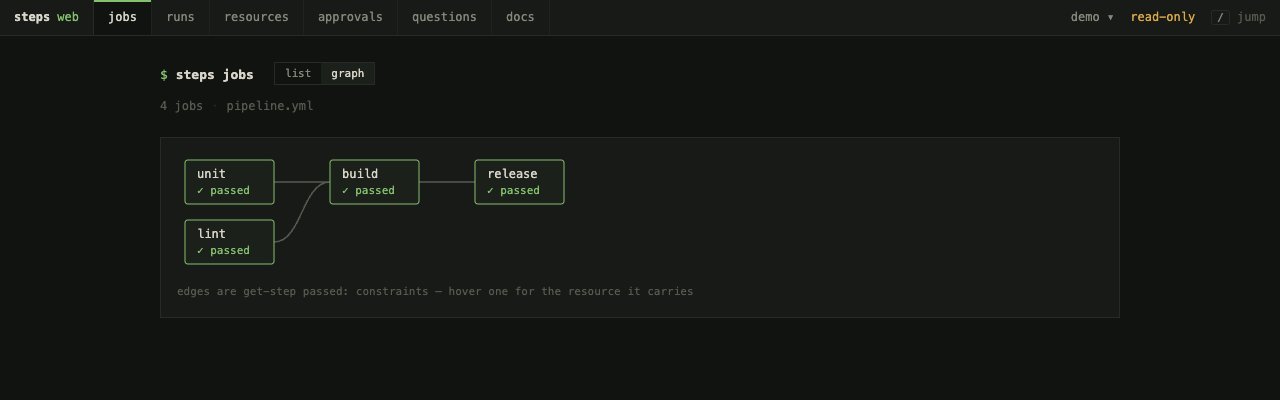
passed: constraints. Every node carries its latest status; hover an edge for the resource it carries.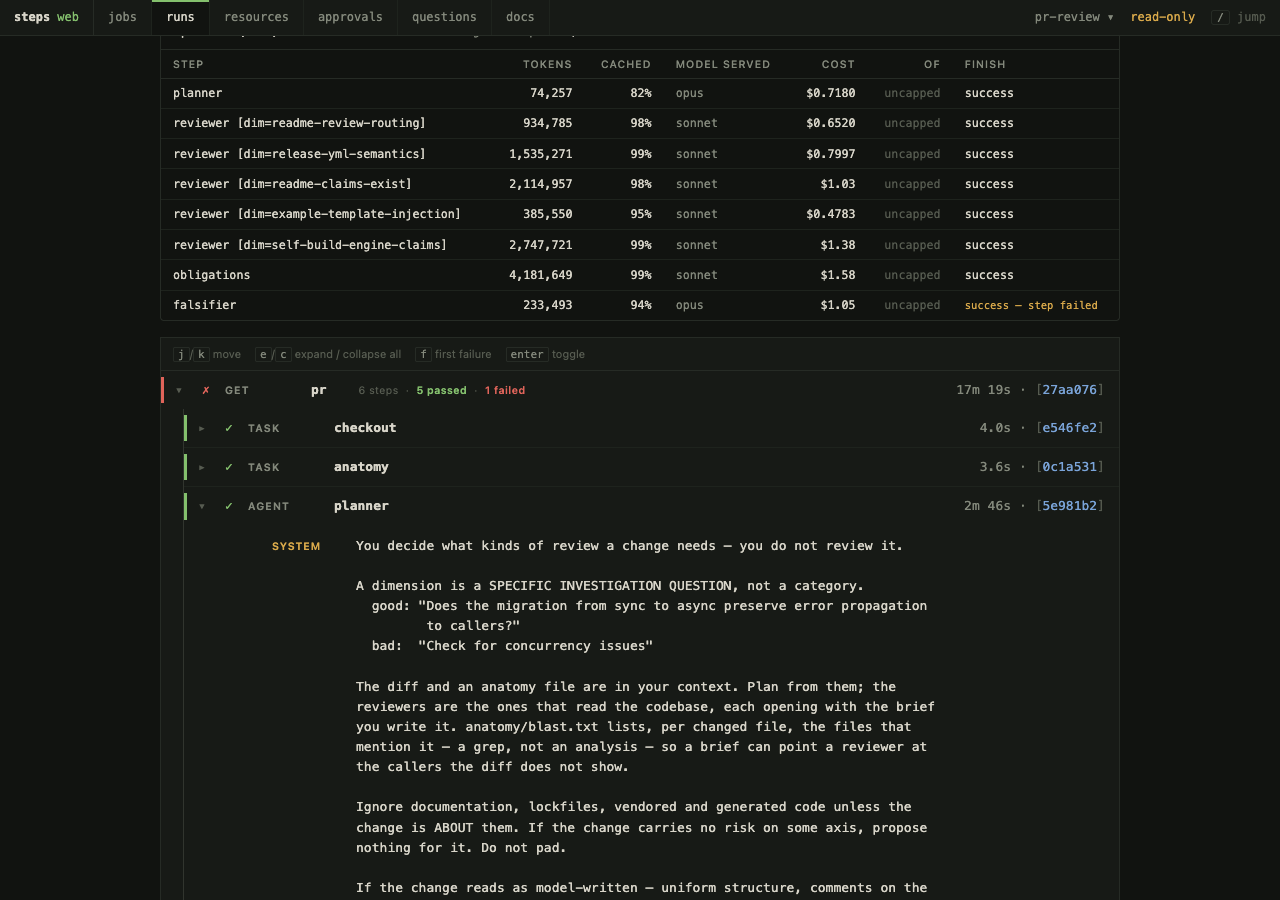
unpriced rather than $0.00.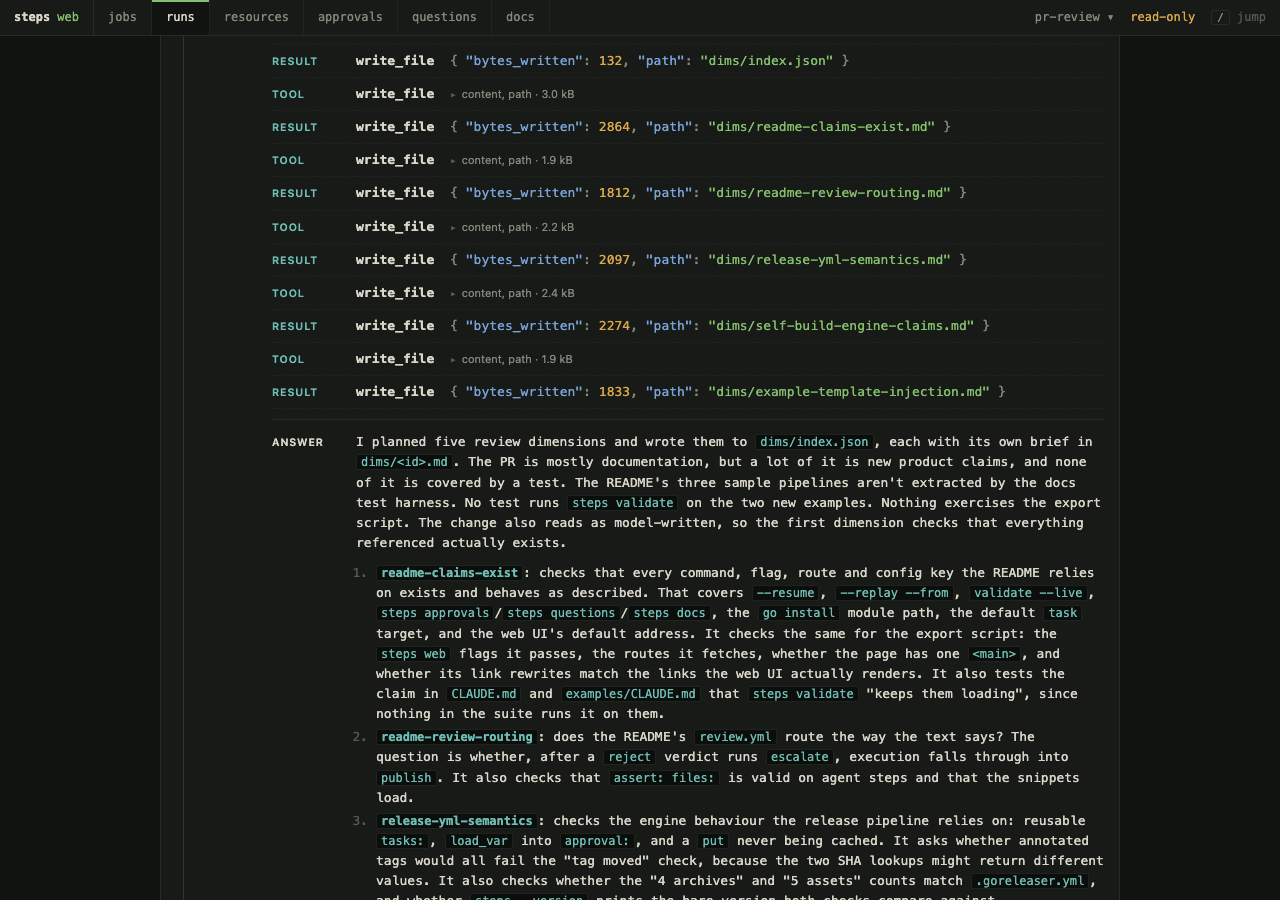
Press / for a jump palette over pipelines, jobs and runs. j/k walk a transcript, f jumps to the innermost failure. A failed run leads with the error and names the steps whose inputs, command or prompt moved since the last green one. The daemon, in full.
ls ../real-pipelines/ — two more, doing actual jobs
Build an issue into a draft PR
Label an issue self-build. An opus planner (read-only) writes the plan, a sonnet implementer executes it, an empty-diff gate stops a no-op before review, an opus reviewer either approves or sends the diff back — then commit, push, gh pr create --draft.
Release steps itself
A new v* tag on GitHub → the whole validation suite as the gate → approval: → goreleaser as a put, because a publish must never be a cached skip → download the published archive and check it reports the tag.
Release notes by email
One message per release: what changed and the download. No newsletter, no drip.